
Lincoln County Tax Record Fields
Lincoln County splits tax records between two offices. The Board of Tax Assessors maintains the appraisal roll. It also applies the exemptions a parcel qualifies for. The Tax Commissioner issues and collects the bill instead, so a field shown in one system may not appear in the other. The county's qPublic pages follow the most recent published digest rather than a live closing feed.
| Field | Meaning in the tax trail | Record keeper |
|---|---|---|
| Fair market value | County estimate of full value as of January 1 | Board of Tax Assessors |
| Assessed value | Forty percent of fair market value before relief or special-class rules | Board of Tax Assessors |
| Exemptions | Homestead or other relief for qualifying property | Board of Tax Assessors |
| Bill and payment | Amount billed and payment status | Tax Commissioner |
| Recorded transfer | Deed consideration and filing reference | Clerk and GSCCCA PT-61 |
Georgia law fixes a forty percent ratio. Real property is assessed from fair market value. Exemptions or current-use treatment can alter the taxable result, and millage then drives the bill, so no figure is automatically a price a buyer would pay.
Lincoln County's Forty Percent Rule
Lincoln County values property every January 1. The Georgia Department of Revenue valuation guidance and the county's own assessor information both describe that annual schedule. Picture a home the county estimates at $250,000. The assessed value comes out to $100,000 before exemptions or special classifications.
That is only the beginning of the math. Taxing authorities apply millage to the taxable assessment. A homestead exemption can shrink what is taxed. Conservation-use land follows its own current-use method. Compare figures from the same tax year and keep every label intact.
- Fair market value
- The assessor's estimate of full value under Georgia rules.
- Assessed value
- The statutory part of fair market value used in tax work.
- Millage
- A rate applied by taxing authorities to taxable assessment.
- Homestead exemption
- Relief for qualifying owner-occupied property.
- Tax lien
- A claim tied to unpaid property tax.
Search Lincoln County Assessments
The Lincoln County qPublic assessor page opens a parcel search run through Schneider. Lookups can go by address, owner, parcel, or map. Start with a situs address. If nothing comes back, try a partial street name, an owner-name variant, or a parcel number you already know.
| Lookup route | Input to try | Use in the tax check |
|---|---|---|
| Address | Physical situs address | Find the parcel and digest entry |
| Owner | Person or legal entity | Find parcels under an indexed name |
| Parcel | Exact APN | Carry a stable key between offices |
| Map | Known location | Confirm the tax-map unit, not a surveyed line |
The assessor page below opens the published digest search.
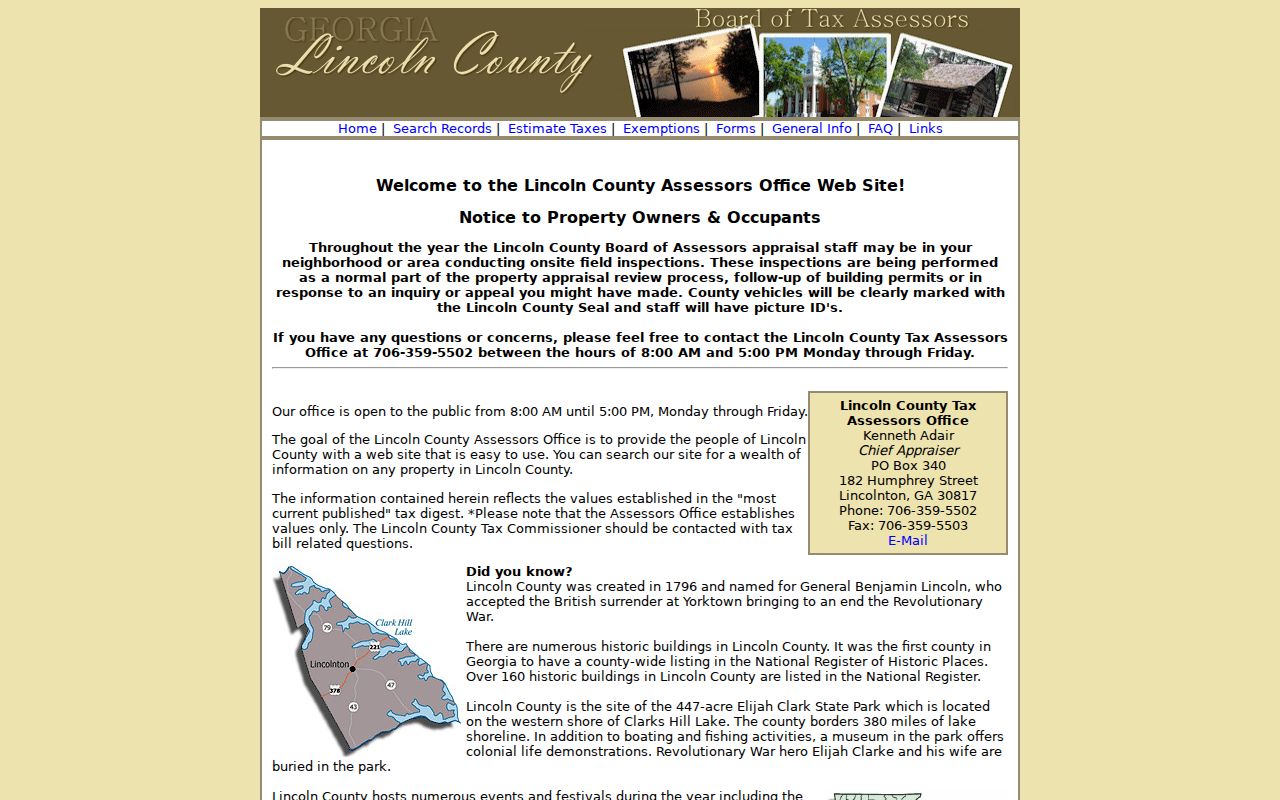
Save the essentials from any live result. Note the parcel ID, tax year, fair market and assessed values, exemptions, and any land or improvement breakdown shown.
Find a Lincoln County Tax Bill
Bill questions and collections belong to the Tax Commissioner, not the assessor. The payment landing page offers a Property Taxes option. How far back searches go is not stated. Start from the qPublic parcel facts, then carry the exact parcel number and address into the payment route.
- Search qPublic by situs address and copy the parcel number, tax year, value, and exemption fields.
- Open the Lincoln County GovernmentWindow portal and choose Property Taxes.
- Match the account to the parcel and tax year. Read the amount and payment status shown.
- Contact the Tax Commissioner when older bills, fees, delinquency, or sale status are unclear online.
The Tax Commissioner's office sits at 210 Humphrey Street, P.O. Box 946, Lincolnton, Georgia 30817, and answers the phone at 706-359-5536. Doors are open weekdays from 8:00 a.m. to 4:45 p.m. Published materials do not state how far back past years can be searched. Call ahead for older accounts.
Lincoln County Property Tax Relief
Lincoln County property tax records shrink for many owners through relief programs. The county's exemption guidance covers homestead, age-based, disabled-veteran, surviving-spouse, and conservation-use categories. A standard homestead exemption knocks $2,000 off within applicable state, county, and school limits. To qualify, the owner must hold and occupy the home as a legal residence on January 1. The first application must also be filed. The basics are simple. Live in it, apply, keep the paperwork.
Other programs reach further. Local material lists a $4,000 exemption at age 65 under qualifying income rules. A school exemption of up to $10,000 in assessed value applies at age 62. Disabled veterans and qualifying unremarried surviving spouses may claim $50,000. Eligibility rules and the current forms control, so confirm details before filing. The official Lincoln County exemption page lays out each category and its requirements.
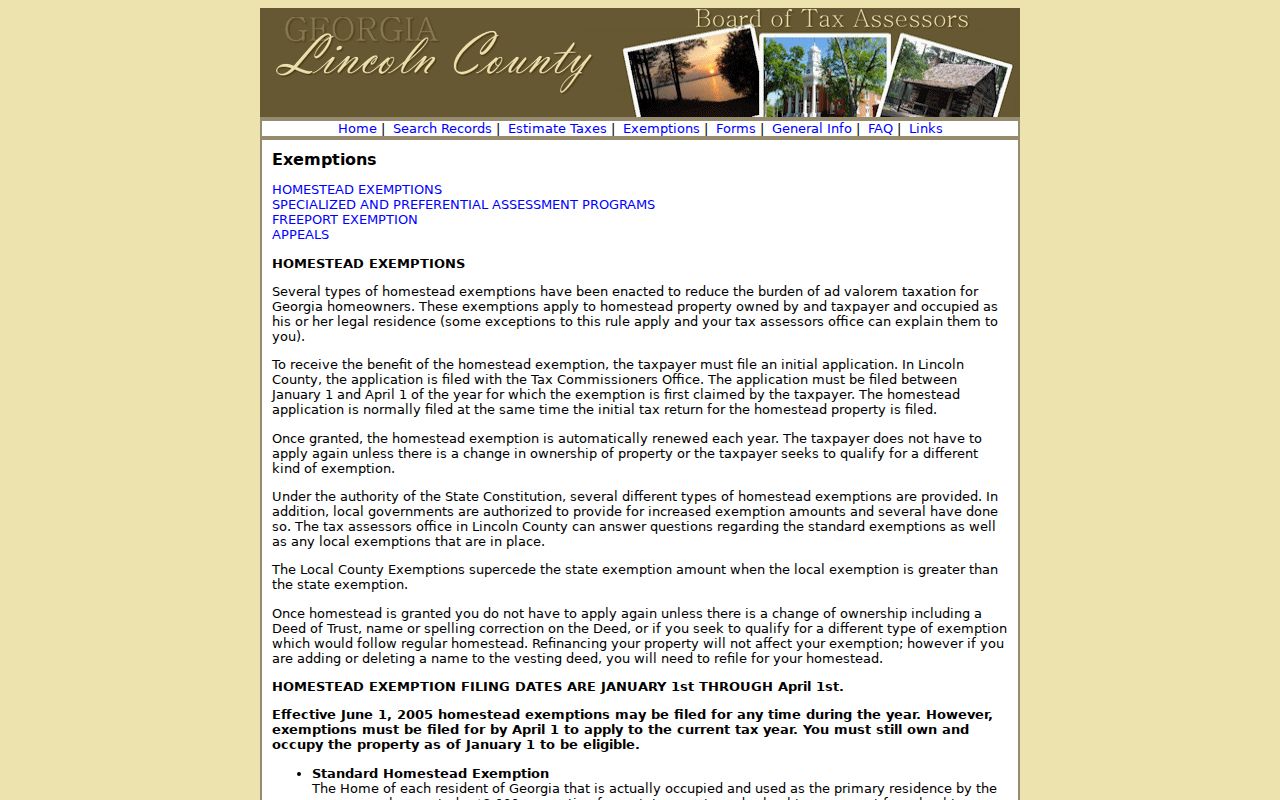
Most local exemption forms carry an April 1 deadline. One age-62 item lists June 1 instead, so confirm dates on the Lincoln County forms list before filing.
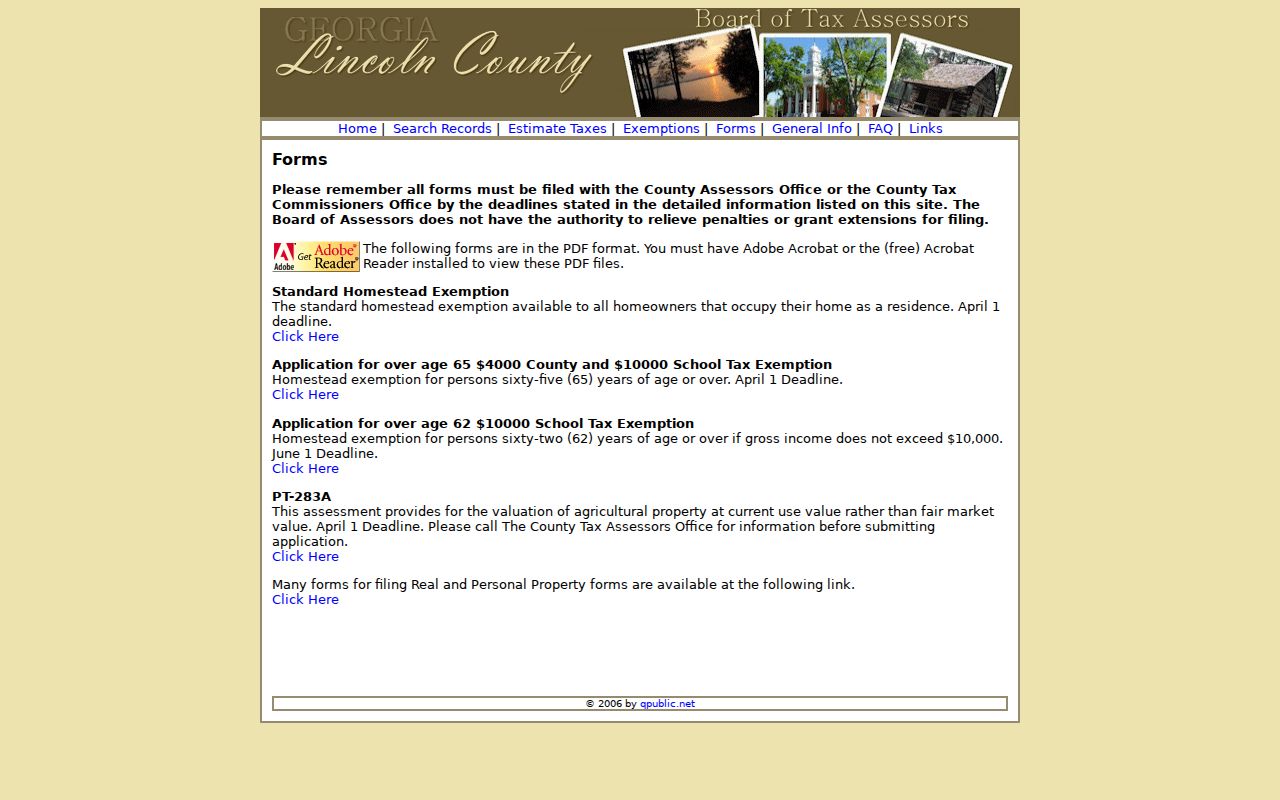
Always choose the current local document. A summary from an older filing cycle can mislead on amounts or deadlines.
Lincoln County Current-Use Covenants
Agricultural, timber, environmentally sensitive, or transitional land can qualify. Qualifying parcels receive current-use valuation. Lincoln County's published terms set an April 1 application deadline, a $25 recording fee, a ten-year covenant, and a 2,000-acre statewide limit. Breaking the covenant can bring penalties.
The county keeps fair market value on file. That value can still be appealed even when current-use value controls the tax. Before a sale, split, or change of use, compare the covenant papers with the assessment. A low taxable figure may reflect the special class, not a low estimate of full value.
Contest a Lincoln County Assessment
The Board of Tax Assessors sets value and taxability and mails the notice. Taxpayers file the appeal with that same board. Review then goes to the Board of Equalization, or to arbitration if chosen at filing. No deadline, form, or hearing calendar is posted.
Use the notice date. Confirm the deadline printed on the current assessment notice and with the assessor before filing a Lincoln County appeal.
File by the deadline and keep proof of delivery. Strong support might include a recent appraisal, truly comparable sales, photographs, corrected acreage or building facts, and a survey where land area is disputed. Remember what an appeal targets. It contests the assessment itself, not a Tax Commissioner payment entry.
Lincoln County Delinquent Tax Trail
Skip a tax bill in Lincoln County and the trail starts with a writ of fieri facis. That is the familiar fi. fa. It is followed by collection steps and possible sale notices. Follow the account with the Tax Commissioner, and check the GSCCCA lien index for recorded filings. Also watch the Lincoln Journal, the legal organ that publishes notices. A notice freezes one moment in time. The amount may since have been paid, released, or changed.
A tax deed issued after sale is not a warranty deed. Careful work means pulling the tax file and the sale notice. Pull the deed too, and any later court or redemption records. When the online trail runs thin, contact the Clerk and the Tax Commissioner directly.
Lincoln Tax Office Changed in 2025
Georgia House Bill 1008 amended the local act governing Lincoln County's Tax Commissioner structure, effective January 1, 2025. The law merged the former Tax Receiver and Tax Collector functions into that single office. Some older forms still carry labels that no longer match the current route.
For present property tax records, use the current Assessor and Tax Commissioner contacts. For a historic file, keep the office name printed on the document. Explain its date rather than silently modernizing it.
The change did not fold appraisal and collection into one record. Kenneth Adair serves as Chief Appraiser at 182 Humphrey Street. He is reachable at 706-359-5502 on weekdays from 8:00 a.m. to 5:00 p.m. The Tax Commissioner keeps a separate phone, mailing address, and closing time. Route a value or exemption issue to the assessor. Route a bill, receipt, payment, or delinquency question to the Tax Commissioner.
When neither portal holds an older item, ask the office that created it. A Georgia Open Records Act request works best when it names the parcel, tax year, and record wanted. Request electronic copies where practical. Ask for a cost estimate up front. Agencies generally respond within three business days or provide a written production date, cost figure, and any exemption basis. Ordinary copying is generally capped at $0.25 per page. The first 15 minutes of search and retrieval are free.
Ask for the notice of assessment whenever you trace how a value entered the digest. That notice anchors the appeal window and identifies the value at issue. Keep proof of your filing date and chosen route. The local exemption material lists homestead, age-based, veteran, and conservation-use options. Each carries its own eligibility facts and deadline. An exemption changes the taxable result only; it never revises the deed chain.
Conservation-use land carries a ten-year covenant under the local material. A sale, a change of use, or a breach can trigger consequences that one year's bill will not reveal. Pull the covenant and assessor file before comparing such a parcel with an ordinary residential tract. Delinquency deserves the same patience. A fi. fa. index hit may have a later cancellation or release. Search past the first filing and ask the Tax Commissioner for current status.
Finally, keep the tax year, payment date, receipt number, and office response together as one dated set. That discipline separates a current status check from an older portal screen and makes later corrections far easier to trace.