
Lincoln County Deed Types
Every Lincoln County deed record starts with the instrument. A deed names the parties. It describes the land. It also carries a recording reference such as book and page. Some deeds state the sale price outright. Others point to a PT-61 transfer declaration filed with the state. The Georgia Superior Court Clerks' Cooperative Authority search hub splits its tools into separate searches. Those cover real estate, liens, plats, and PT-61 filings. That separation is deliberate. A deed conveys an interest in land, but a security deed, lien, release, easement, or plat each answers a different question about the same parcel.
| Deed Type | What It Does | Common Use |
|---|---|---|
| Warranty deed | Conveys title with promises from the grantor | Ordinary arms-length sale |
| Quitclaim deed | Conveys only the interest the grantor may hold | Family transfer or title cleanup |
| Executor or trustee deed | Transfers property through an authorized fiduciary | Estate or trust administration |
| Tax deed | Records a transfer tied to a tax sale | Delinquent-tax proceeding |
| Security deed | Secures a debt rather than serving as the sale deed | Mortgage financing and later release |
Not every recorded instrument transfers ownership. A cancellation simply releases an earlier security deed. Liens and judgments can burden a parcel while leaving the owner of record untouched. Restrictive covenants and rights-of-way shape how land may be used or reached. Before adding any item to a chain of title, match it to its instrument type, parties, execution date, recording date, and legal description.
Search Lincoln County Grantors
The GSCCCA Real Estate Name Search is the primary free route into Lincoln County deed records. Individuals should be entered last name first, as the form directs. To find how a current owner took title, search that person or entity as a grantee. Name variants cause trouble, though. Initials, a trust, an estate, or an LLC can split a single ownership trail across several index entries, so plan on more than one Lincoln County property search before concluding anything.
| Index control | How it narrows deed records | Lincoln search note |
|---|---|---|
| Party type | Chooses the transfer side | Use grantee for an acquisition and grantor for a later transfer |
| Instrument type | Limits the kind of filing | Keep broad when the exact deed type is not known |
| County | Restricts the central index | Select Lincoln County and use neighboring counties only when facts support it |
| Search name | Matches a person or entity | Enter individuals last name, first name |
| Date range | Limits recorded dates | Widen the span when a closing date is only approximate |
| Display controls | Sets rows and table format | Save the recording reference, not just the party name |
The real-estate name form displays the grantor-grantee controls the state index uses for Lincoln County deed records.
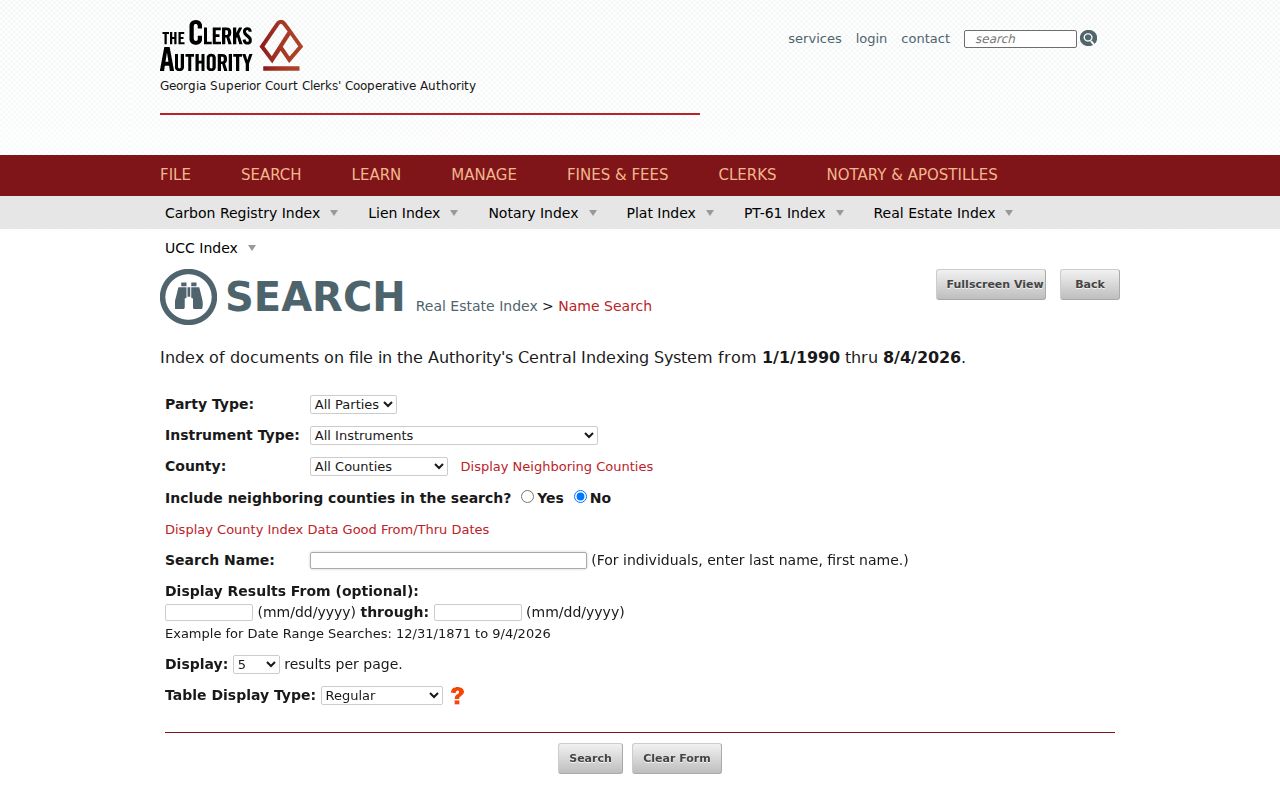
County results still call for a live review. Write down the instrument number, book and page, recording date, type, party lists, and any image link the entry actually shows. Premium image or address features may require an account or fee, so the Clerk of Court remains the reliable fallback for Lincoln County deed records.
Lincoln County Book Page Search
A parcel card, prior deed, or court filing that already cites a book and page lets you skip the name search entirely. Open the GSCCCA book and page form, select Lincoln County, and enter the citation. The system reformats entries to match its indexing standards. A slightly different format is no cause for alarm. This direct recording-reference route works best once the name index or assessor record has produced a citation.
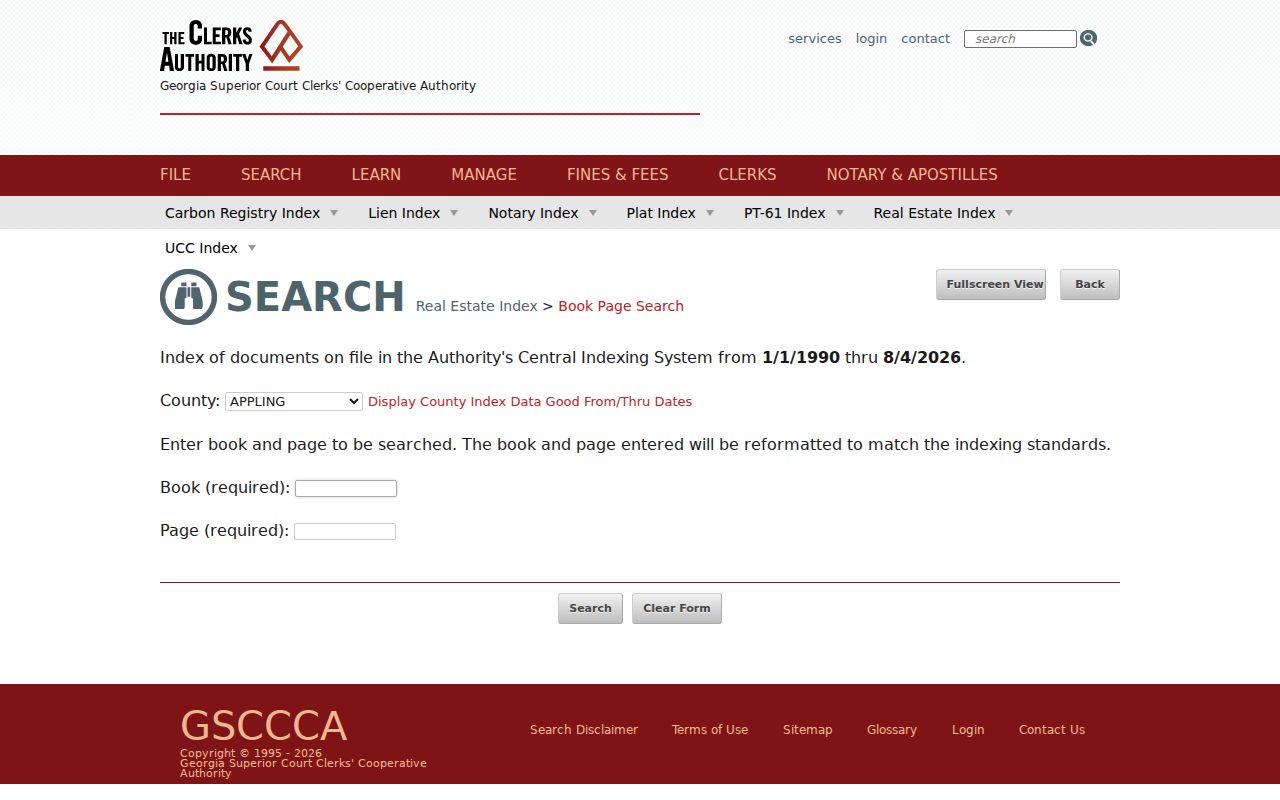
A confirmed book and page sharpens any counter, phone, or written copy request. Ask the Clerk whether the page you cited is an index entry, an image, or the full recorded instrument.
Build Lincoln County Title Chains
A Lincoln County chain of title comes together one transfer at a time. Begin with a well-supported current owner. Then work backward through the grantee side of the deed index. Names alone prove little. At each step, compare acreage, subdivision or land-lot language, adjoining-owner calls, and book/page links. Accept the link in the chain only after those details line up.
- Find the current owner's acquisition by searching that owner as grantee. Open or request the cited instrument.
- Read the grantor name and legal description. Confirm that the land matches the subject parcel.
- Search that grantor as a grantee in an earlier date range. Repeat the comparison and save each recording reference.
- When the online path ends, carry the last known name, date, and book reference to the Clerk or historical repository.
- Grantor
- The person or entity transferring an interest.
- Grantee
- The person or entity receiving that interest.
- Chain of title
- The linked sequence of transfers for the same land.
- Book and page
- A location in the recorded volumes or their indexed image set.
- Instrument number
- A distinct filing identifier that may supplement a book and page.
Lincoln Deeds Before 1990
GSCCCA states that its central real-estate index begins January 1, 1990. It runs through the date the service currently displays. That is a statewide statement. It does not prove that every Lincoln County image opens on that same day. And it says nothing about the county's own imaging cutover. Lincoln County deed records reach far earlier than 1990. Ask the Clerk which images can be viewed online. Ask too which grantor-grantee books must be pulled at the counter.
Know the cutoff. The 1990 date describes the central index baseline, while Lincoln County's older deeds may remain in books, microfilm, or archives.
This distinction prevents false gaps in a search. An empty web result may simply mean the transfer predates the central index or that the name was indexed differently. It never proves the deed does not exist.
Lincoln County's 1796 Land Trail
Lincoln County's deed history runs far past any online baseline. Archival finding aids identify deeds and mortgages from 1796 through 1909. Surveys run from 1798 through 1847, and warrants from 1796 through 1855. Deed Book K covers 1806 through 1808. Those series fit a county carved from Wilkes County in 1796. So the earliest Lincoln County deed records may sit in the parent county's books. The Digital Library of Georgia courthouse-record collection describes Lincoln material spanning 1700 through 1927. The collection includes plats, debt papers, powers of attorney, and writs of fieri facias. The Georgia Archives and local deed books offer further routes. These sources bridge history, but verify the final instrument with the custodian that holds it. Old descriptions may call to a creek, a road, a land lot, a district, or an adjoining owner. The call may name any of these rather than a street address. A recorded plat can connect those words to a later parcel.
Access Lincoln County Deed Records
Online access is only one channel. The Clerk of Superior Court profile lists Amanda Doss at 210 Humphrey Street, P.O. Box 340, Lincolnton, Georgia 30817, phone 706-359-5505. Call ahead before any visit. Confirm terminal access, imaging hours, copy methods, and current fees. The Clerk posts no copy or certification price, so never assume what a request will cost.
For a phone or mail request, give the party name, instrument type, and approximate year. Add the book and page if known. Include enough legal-description detail to identify the land. A Georgia Open Records Act request can ask for electronic copies and a written cost estimate. The agency generally must produce records within three business days, or it must provide a written date, cost, and exemption explanation.
Older items may fall outside the online index. Ask about the counter books and microfilm, then check the Georgia Archives, Digital Library of Georgia, and the Lincoln County Library's John Cullars Genealogy Room. Offline does not mean closed.
Request a Lincoln County Deed
An online image works when it answers the question. Ask the Clerk for a certified copy whenever an official version is required. State the exact instrument or book and page reference. If only an index hit is available, request the full deed plus any referenced exhibit or legal-description attachment. Check on payment before sending funds. No official source posts the current Lincoln County counter and certification fees.
Recorded, not guaranteed. Lincoln County deed records show filed instruments, not a title opinion; unrecorded interests and later filings may affect ownership.
Date every copy or print. Note how it was obtained. For a purchase, boundary dispute, or easement question, a qualified title professional or attorney can assess the full chain and its exceptions. The public index is a research tool. It is not a promise of clear title.
Older Lincoln instruments may need a deed-book or general-index search at the counter. Bring every known grantor, grantee, date, legal description, and prior reference. The Georgia Archives and Digital Library of Georgia add context to early land and court papers, while the Clerk remains the source for the recorded county instrument and certification.