
Trace Lincoln Owners Transfer by Transfer
A backward chain starts from one current deed and treats every earlier transfer as its own row of evidence. The grantor conveys the interest. The grantee receives it. Book and page numbers plus the legal description keep the search anchored to the same Lincoln County parcel even when identical surnames keep appearing across generations, which happens often in older deed records.
| Transfer date | Grantor to grantee | Deed type | Record reference |
|---|---|---|---|
| Newest matching date | Prior owner to current grantee | As indexed | Instrument or book/page |
| Next earlier date | Earlier owner to that grantor | As indexed | Instrument or book/page |
| Repeat backward | Each prior grantor to grantee | Warranty, quitclaim, estate, or other deed | Book/page plus legal description |
Build the timeline only from real index results and deed images, never invented Lincoln County transactions. A quitclaim deed releases whatever interest the grantor held, while a warranty deed carries stronger promises about title. Neither label alone proves the chain is complete, so read each instrument before trusting the sequence.
Lincoln's Online Chain Starts at 1990
The GSCCCA Real Estate Name Search states that its central indexing data begins January 1, 1990. It runs through the current date shown. That date is a statewide baseline, not a guarantee that every Lincoln County deed image starts there. Older records exist. The Clerk can confirm local imaging and access to pre-1990 indexes. Search controls cover party type, instrument type, county, neighboring counties, name, date range, result count, and display style. Enter individuals last name first. The optional property mode is subdivision based. Not every county participates, so it should not replace a name or book/page search. The official name-search screen shows the controls that start the backward walk.
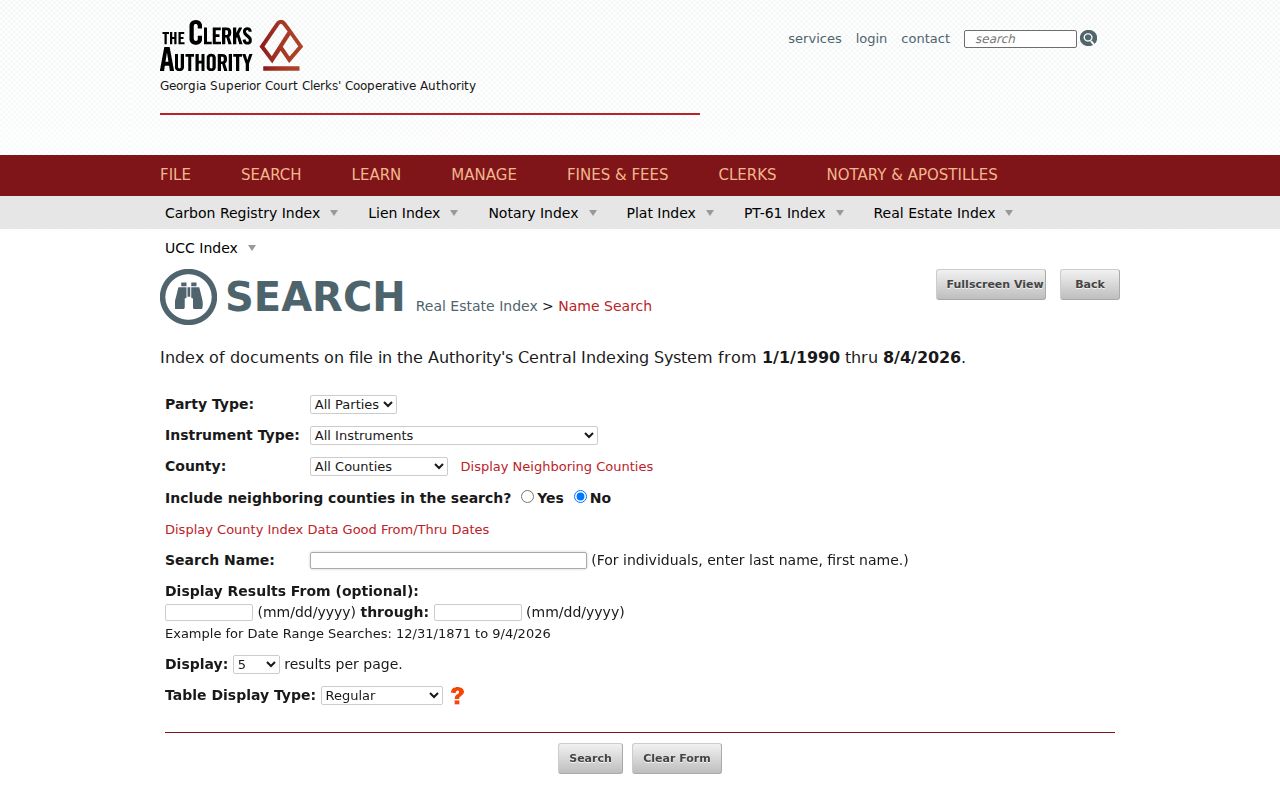
Party, county, name, and date filters help isolate one former owner before the deed reference moves to the next step.
Online cutoff. The published central index begins in 1990; earlier Lincoln County former owners require deed books, indexes, or historical repositories.
Reconstruct Lincoln's Deed Chain
Start with the current deed. It names the immediate prior owner and gives the legal description. Search that grantor as a grantee in an earlier transaction. Then repeat. Continuity of the same land and interest matters more than a string of similar names. The chain may already yield a citation. The GSCCCA book/page form then leads straight to that indexed instrument.
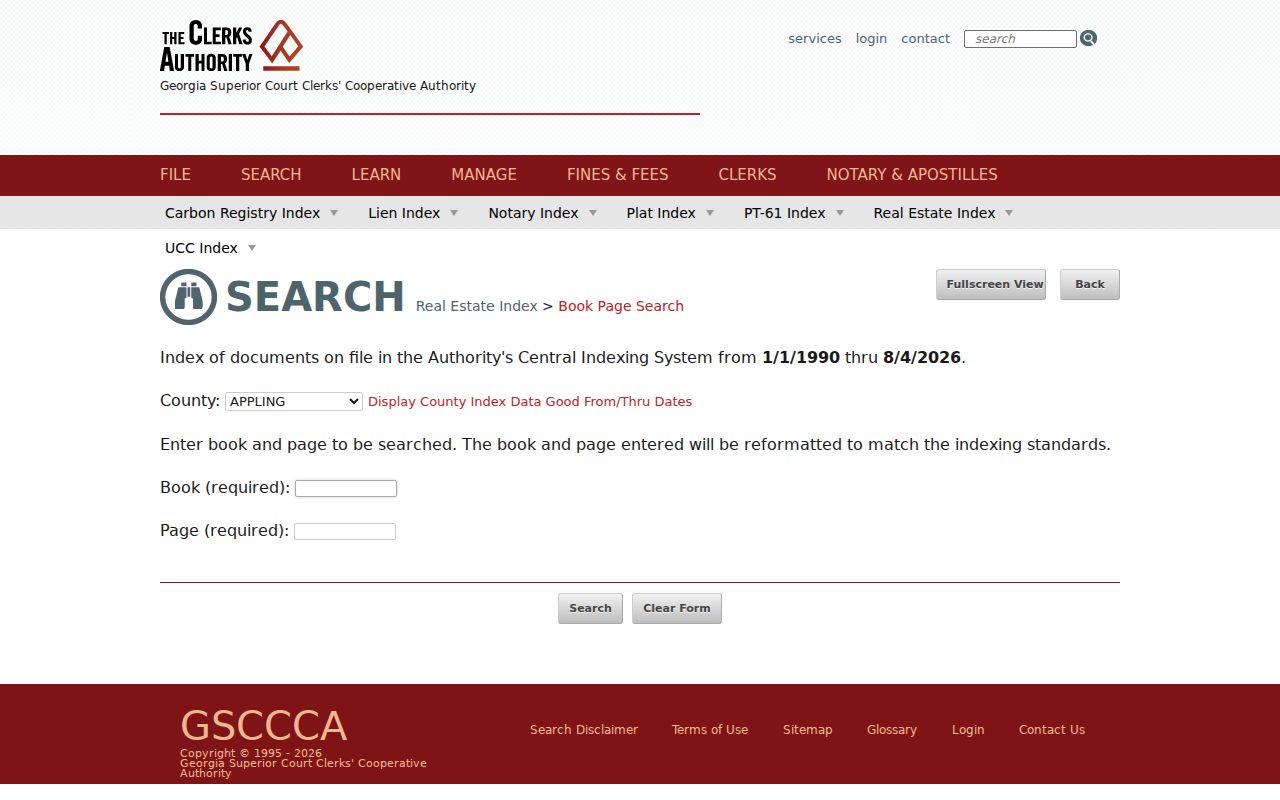
The county, book, and page fields pin the search to one recorded deed rather than a party who merely shares a name.
- Use qPublic or a known deed reference to identify the current parcel and vesting deed.
- Read the grantor, grantee, date, deed type, book/page, and complete legal description.
- Search the grantor as a grantee in the prior period, then compare acreage, land lot, district, plat, and adjoining calls.
- Move to the Clerk's older indexes and deed books when the online results stop.
- Grantor
- The party conveying an interest.
- Grantee
- The party receiving an interest.
- Chain of title
- The ordered series of recorded transfers for the same land.
- Reverse index
- An index organized to help locate a party on the opposite side of a transfer.
- Legal description
- The deed language identifying the land, which can outlast a street address.
Lincoln Deed Books Reach to 1796
Historical finding aids identify Lincoln County deeds and mortgages from 1796 through 1909. A general index spans 1796 through 1905. They also point to Deed Book K covering 1806 through 1808. Surveys run from 1798 through 1847. Warrants cover 1796 through 1855, and homestead records reach from 1867 through 1934. Confirm custody and image access for each volume. Those ranges prove a web cutoff is not the end of the story. Older deeds may name roads, waterways, adjoining owners, witnesses, family ties, acreage, and dower releases. Search with the legal description. Use period place terms rather than forcing a modern address into an old index. Note: Verify each historic volume's custody and image availability before relying on remote access.
Plats Bridge Lincoln's Old Descriptions
A recorded plat can link a lot-and-block reference to the modern parcel. It can also link a rural tract to the modern parcel. The GSCCCA Plat Index accepts name, Sec/GMD, district, land lot, date range, and display controls. Compare the plat's subdivision, phase, lot, block, roads, bearings, and adjoining tracts against the deed. For metes-and-bounds land, map calls to roads, creeks, bearings, and distances. A current GIS map helps orient the search but proves nothing about the old boundary. Splits, consolidations, subdivisions, and annexation can change the tax identifier. The deed chain still carries the earlier description.
Probate Alters Lincoln Owner Timelines
Not every ownership change comes from a sale. A probate file may hold a will or year's-support petition. It may also hold letters of administration, an inventory, an order of sale, or a family statement. An executor or administrator deed then records the transfer through the Clerk. A death certificate fixes a date but does not establish title. Search the decedent and the estate representative in GSCCCA. Then ask the Probate Court for the estate file. Match the legal description before adding any transfer to the chain. A divorce decree or quiet-title order can also explain a gap. So can a partition case or condemnation file the deed index alone leaves open.
Lincoln Archives Extend Former-Owner Research
The Digital Library of Georgia courthouse collection describes Lincoln County material dated 1700 through 1927. The papers include plats, writs of fieri facias, petitions, affidavits, powers of attorney, and debt collections. These papers add context when an early title trail crosses a judgment, an estate, or a court order.
The Lincoln County Library's John Cullars Genealogy Room staffs a full-time genealogist. The room keeps local-history resources too. Ask about maps, family files, old photographs, cemetery notes, newspapers, and directories without assuming any specific year exists. Georgia Archives and the Lincoln County Historical Society deepen the place and family picture. Still, the deed chain remains the ownership evidence; these sources explain it.
Judge Lincoln's Ownership Depth Carefully
Lincoln County was created from Wilkes County in 1796. A chain reaching the county's formation may continue in predecessor-county or state land material. Lincolnton became the county seat in 1800, and the 1915 courthouse still anchors local record keeping. Dates orient a search. They do not prove any particular volume survives or sits online.
Call the Clerk at 706-359-5505 for access to older indexes, terminals, and deed books. A written Georgia Open Records Act request should name the parcel, the parties, the instrument type, book and page, and the date range. Ask about electronic copies and a cost estimate. The office generally must respond within three business days. Or it must supply a production date, cost, and exemption basis.
For the present record rather than the chain back, turn to the Lincoln County current property owner page. Keep past-owner research in the past tense. Never infer a living person's current address from an old deed.
Source labels matter throughout this work. A central-index entry, a digitized courthouse item, a deed-book image, and a library family file each carry different weight. Cite the repository, series, volume, page, and date for every link in the chain. If a step rests only on a surname or a nearby place, treat it as a lead. A deed, probate order, or other recorded transfer must tie the same land together.
Boundary changes also matter. Lincoln County was formed from Wilkes County, so the oldest local ownership may live in predecessor records. Later descriptions may use Clark or Clarke, road abbreviations, or a historic place such as Chennault Plantation. Test name variants, then confirm the parcel through land calls and adjoining owners. Context helps locate an instrument; it cannot supply a missing conveyance.
Lawful use. Former-owner records support house history, estate work, and property diligence. Never use an old name or address to stalk, harass, threaten, or target a person.
When no transfer appears, mark the gap rather than guessing at it. Search probate, court, lien, and plat records near the same dates, and ask which older index covers the period in question.